Appendix E: New World Order

Club of Rome Report
Regionalized And Adaptive Model
Of The Global World System
Report on the Progress in the
- STRATEGY FOR SURVIVAL PROJECT
- of the
- Club of Rome
Mihajlo Mesarovic and Eduard Pestel, Directors
Confidential
September 17, 1973
1. Motivation and Objectives The world problematique formulated by the CLUB OF ROME is not only global in nature, involving factors traditionally considered as unrelated, but also points to the crisis situations which are developing in spite of the noblest of intentions and, indeed, as their corollary. To point out the problematique and the spectrum of critical and traumatic situations it entails is not enough; the acceptance of the reality of the problematique MUST BE FOLLOWED BY CHANGES IF THE CONCERN IS NOT TO REMAIN PURELY ACADEMIC. It is necessary, therefore, to present the issues within the problematique in specific and relevant terms which requires regions interpretation of the global issues. Furthermore, a basis should be provided for the resolution of conflicts (inevitably accompanying the problematique-type situations) through cooperation rather than confrontation. These factors have provided the motivation for initiation of the Strategy for Survival project which calls for the construction of a regionalized and adaptive model of the total world system with tht following specific objectives:
(1) TO ENABLE THE IMPLEMENTATION OF SCENARIOS FOR THE FUTURE DEVELOPMENT OF THE WORLD SYSTEM which represent visions of the world future stemming from different cultures and value systems and reflecting hopes and fears in different regions of the world.
(ii) To develop a planning and options-assessment tool for long-range issues, and thereby TO PROVIDE A BASIS FOR CONFLICT RESOLUTION by cooperation rather than confrontation. 2. Basic Structure of the Model The basic characteristics of the model are:
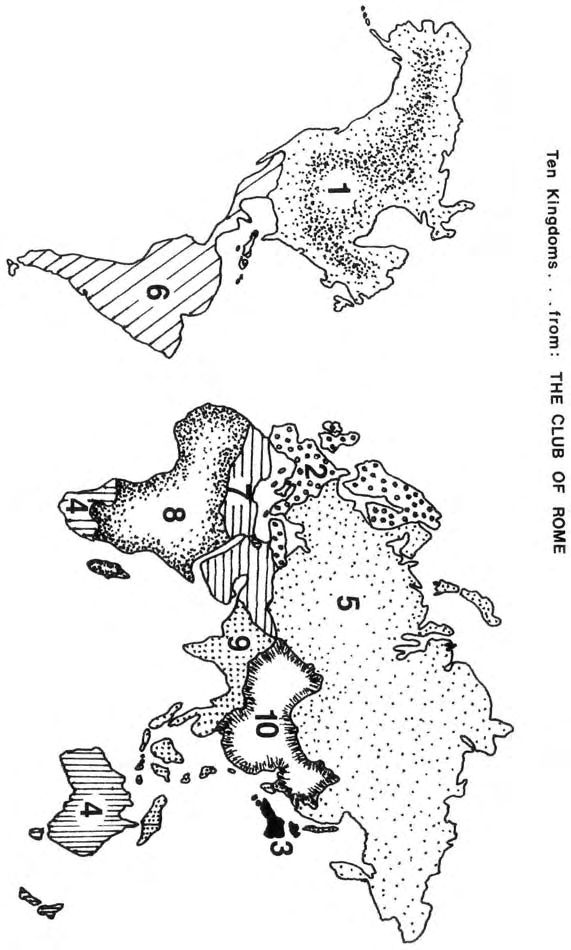
(i) THE WORLD SYSTEM IS REPRESENTED in terms of interacting regions with provisions made to investigate any individual country or subregion in the context of regional and global development. Presently the world system is represented BY TEN REGIONS: NORTH AMERICA, WESTERN EUROPE, EASTERN EUROPE, JAPAN, REST OF DEVELOPED WORLD, LATIN AMERICA, MIDDLE EAST, REST OF AFRICA, SOUTH AND SOUTH EAST ASIA, AND CHINA.
(ii) In order to be able to deal with the complex of factors involved in problematique in a way which is sound, credible and systematic, a hierarchical structure has bee adopted for the model in which each level in the hierarchy represents the evolution of the world system within a context defined by a given set of laws and principles. Specifically, the levels involved are: GEO-PHYSICAL, ECOLOGICAL, TECHNOLOGICAL (MAN-MADE ENERGY AND MASS TRANSFERS), ECONOMIC, INSTITUTIONAL, SOCIOPOLITICAL, VALUE-CULTURAL AND HUMAN-BIOLOGICAL. Such and approach enables an optimal use of confirmed scientific knowledge and available data,
(iii) An adequate view of the conditions in which the problematique is emerging and under which the solutions must be found require the recognition of the purposive aspects of the human community and adaptiveness of human beings. The model of the world system will have, therefore, two parts: (1) the so-called causal part, representing dynamical processes which follow histoical patterns of development and (2) the so-called goal-seeking part which represents purposive changes under new conditions. The goal-seeking part in turn includes two
levels: the decision-making or actions level and the norms level; the former represents the purposive response of the system while the latter represents the values and norms which constrain and condition such a response. 3. Progress in the Model Construction The construction of the model as described in Sec. 2 and with the objectives as specified in Sec. 1 is certainly a rather complex task and the research is organized to proceed in parallel in several directions. The overall assessment of the model status is the following: The model has been developed up to the stage where it can be used for policy analysis related to a number of critical issues, such as: energy resources utilization and technology assessment; food demand and production; population growth and the affect of timing of birth control programs; reduction of inequities in regional economic developments; depletion dynamics of certain resources, particularly oil reserves; phosphorus use as fertilizer; regional unemployment; constraints on growth due to labor, energy or export limitation, etc.
Specific developments which enable use of the model as described above include the following:
1. A COMPUTER MODEL OF THE WORLD ECONOMIC SYSTEM HAS BEEN DEVELOPED AND VALIDATED BY AN EXTENSIVE SET OF DATA. The model has two levels - macro and micro. On the MACRO LEVEL the model of each region INCLUDES THE GROSS REGIONAL PRODUCT, TOTAL IMPORTS AND EXPORTS, CAPITAL AND LABOR PRODUCTIVITY AND VARIOUS COMPONENTS OF FINAL DEMAND SUCH AS PUBLIC CONSUMPTION, GOVERNMENT EXPENDITURE, AND TOTAL INVESTMENT. ON THE MICRO LEVEL EIGHT PRODUCTION SECTORS ARE RECOGNIZED: AGRICULTURE MANUFACTURING, FOOD PROCESSING, ENERGY, MINING, SERVICES, BANKING AND TRADE, AND RESIDENTIAL CONSTRUCTION. The input-output framework is used for the intermediate demands. A FULL SCALE MICRO TRADE MATRIX ALSO HAS BEEN DEVELOPED.
2. A WORLD POPULATION MODEL HAS BEEN CONSTRUCTED IN TERMS OF THE SAME REGIONS AS THE ECONOMIC MODEL. The model has been validited by the data available. In each region the population structure is represented in terms of four age groups with appropriate delays which make possible assessment of population momentum and assessment of the effectiveness of implementation of various population control measures.
3. AN ENERGY MODEL HAS BEEN CONSTRUCTED which gives for each region the consumption and production of energy and interregional exchange of energy resources as a function of economic factors. Energy is treated both in composite terms and in reference to individual energy sources, namely solid fuel, liquid fuel, nuclear, gas and hydro. 4. A FOOD PRODUCTION AND ARABLE LAND USE MODEL HAS BEEN CONSTRUCTED which allows the assessment of a number of food related issues including: the need and availability of phosphorus required for intensive agriculture, AND THE CONSEQUENCES OF TIMING AND MAGNITUDES OF NATURAL DISASTERS SUCH AS DROUGHT, CROP FAILURE DUE TO DISEASE, ETC.
5. A MAJOR CONCERN IN THE APPLICATION OF THE COMPUTER MODEL is its proper utilization so as to avoid dependence on the deterministic aspects of model operation. In order to avoid this an interactive method of computer simulation analysis has been developed. THE METHOD REPRESENTS A SYMBIOSIS OF MAN AND COMPUTER IN WHICH THE COMPUTER PROVIDES THE LOGICAL AND NUMERICAL CAPABILITY WHILE MAN PROVIDES THE VALUES, INTUITION AND EXPERIENCE. The method utilizes an option specification and selection program which enables the policy analyst or decision-maker to evaluate alternative options on various levels of the decision process, i.e., with respect to goals, strategies, tactical and implementational factors. SPECIAL ATTENTION IS PAID TO THE NORM CHANGING PROCESSES. 4. Progress in Application THE MODEL HAS BEEN USED both for the assessment of alternative scenarios for future regional and global developments (under different regional conditions) as well as in the interactive mode selection of policy options (specifically for the energy crises issues in developed regions).
OUR EFFORTS IN THE IMMEDIATE FUTURE WILL BE CONCENTRATED ON FURTHER USE OF THE ALREADY DEVELOPED MODEL. THE PLANS INCLUDE EMPHASIS IN THE FOLLOWING THREE DIRECTIONS:
(i) Assessment in the changes over time of the span of options available to solve some major crisis problems.
(ii) IMPLEMENTATION of the regional models in different parts of the world and their connection via a satellite communication network for the purpose of joint assessment of the long term global future by teams from the various regions.
(iii) Implementation of the vision for the future outlined by leaders from an underdeveloped region in order TO ASSESS with the model EXISTING OBSTACLES AND THE MEANS WHEREBY THE VISION MIGHT BECOME REALITY.
'KINGDOMS' : CLUB OF ROME'S TEN GLOBAL GROUPS GROUP 1: North America Canada United States of America
GROUP 2: Western Europe Andorra Luxembourg Austria Malta Belgium Monaco Denmark Netherlands Federal Republic of Germany Norway Finland Portugal France San Marino Great Britain Spain Greece Sweden Iceland Switzerland Ireland Turkey Italy Yugoslavia Liechtenstein
GROUP 3: Japan
GROUP 4: Rest of the Developed Market Economies Australia Oceania Israel South Africa New Zealand Tasmania
GROUP 5: Eastern Europe Albania Hungary Bulgaria Poland Czechoslovakia Rumania German Democratic Republic Soviet Union
GROUP 6: Latin America
Argentina Guyana Barbados Haiti Bolivia Honduras Brazil Jamaica British Honduras Mexico Chile Nicaragua Colombia Panama Costa Rica Paraguay Cuba Peru Dominican Republic Surinam Ecuador Trinidad and Tobago El Salvador Uruguay French Guiana Venezuela Guatemala
GROUP 7: North Africa and the Middle East Adu Dhabi Lebanon Aden Libya Algeria Masqat-Oman Bahrain Morocco Cyprus Qatar Dubai Saudi-Arabia Egypt Syria Iran Trucial Oman Iraq Tunisia Jordan Yemen Kuwait
GROUP 8: Main Africa Angola Ghana Burundi Guinea Cabinda Ivory Coast Cameroon Kenya Central African Republic Liberia Chad Malagasy Republic Dahomey Malawi Ethiopia Mali French Somali Coast Mauritania Gabon Mauritius Gambia Mozambique
Niger South West Africa Nigeria Spanish Guinea Portuguese Guinea Spanish Sahara Republic of Congo Sudan Reunion Tanzania Rhodesia Togo Rwanda Uganda Senegal Upper Volta Sierra Leone Zaire Somalia Zambia South Africa
GROUP 9: South and Southeast Asia Afghanistan Malaysia Bangladesh Nepal Burma Pakistan Cambodia Philippines Ceylon South Korea India South Vietnam Indonesia Taiwan LAOS Thailand
GROUP 10: Centrally Planned Asia Mongolia North Vietnam North Korea People's Republic of China

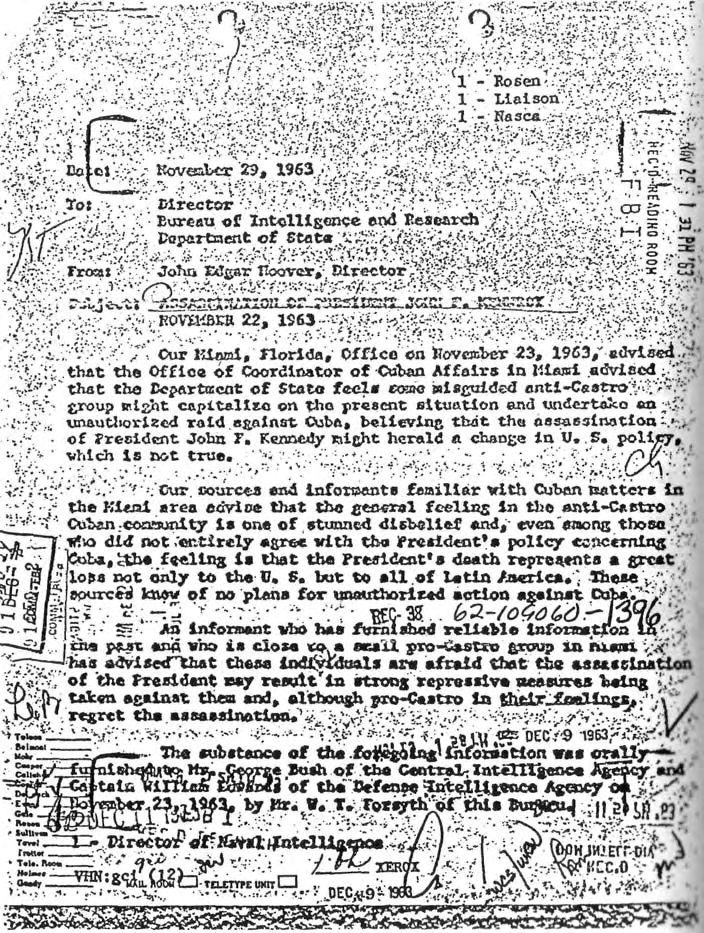
Date: November 29,1963 To: Director Bureau of Intelligence and Research Department of State From: John Edgar Hoover, Director Subject: ASSASSINATION OF PRESIDENT JOHN F. KENNEDY NOVEMBER 22,1963
Our Miami, Florida, Office on November 23,1963, advised that the Office of Coordinator of Cuban Affairs in Miami advised that the Department of State feels some misguided anti-Castro group might capitalize on the present situation and undertake an unauthorized raid against Cuba, believing that the assassination of President John F. Kennedy might herald a change in U. S. policy, which is not true.
Our sources and informants familiar with Cuban matters in the Miami area advise that the general feeling in the anti-Castro Cuban community is one of stunned disbelief and, even among those who did not entirely agree with the President's policy concerning Cuba, the feeling is that the President's death represents a great loss not only to the U.S. but to all of Latin America. These sources know of no plans for unauthorized action against Cuba.
An informant who has furnished reliable information in the past and who is close to a small pro-Castro group in Miami has advised that these individuals are afraid that the assassination of the President may result in strong repressive measures being taken against them and, although pro-Castro in their feelings, regret the assassination.
The substance of the foregoing information was orally furnished to Mr. George Bush of the Central Intelligence Agency and Captain William Edwards of the Defense Intelligence Agency on November 23,1963, by Mr. W. T. Forsyth of this Bureau.
1 - Director of Naval Intelligence
VHN:gci (12)
The Report from Iron Mountain
62 The Report
- though not yet expressly put forth, is the development of
- a long-range sequence of space-research projects with
- largely unattainable goals. This kind of program offers
- several advantages lacking in the social welfare model.
- First, it is unlikely to phase itself out, regardless of the
- predictable "surprises" science has in store for us: the
- universe is too big. In the event some individual project
- unexpectedly succeeds there would be no dearth of sub-
- stitute problems. For example, if colonization of the
- moon proceeds on schedule, it could then become "neces-
- sary" to establish a beachhead on Mars or Jupiter, and so
- on. Second, it need be no more dependent on the general
- supply-demand economy than its military prototype.
- Third, it lends itself extraordinarily well to arbitrary
- control.
- Space research can be viewed as the nearest modern
- equivalent yet devised to the pyramid-building, and
- similar ritualistic enterprises, of ancient societies. It is
- true that the scientific value of the space program, even
- of what has already been accomplished, is substantial on
- its own terms. But current programs are absurdly and
- obviously disproportionate, in the relationship of the
- knowledge sought to the expenditures committed. All
- but a small fraction of the space budget, measured by
- the standards of comparable scientific objectives, must
- be charged de facto to the military economy. Future
- space research, projected as a war surrogate, would
- further reduce the "scientific" rationale of its budget to
- a minuscule percentage indeed. As a purely economic
Substitutes For The Functions Of War 63
- substitute for war, therefore, extension of the space pro-
- gram warrants serious consideration.
In Section 3 we pointed out that certain disarmament models, which we called conservative, postulated extremely expensive and elaborate inspection systems.
- Would it be possible to extend and institutionalize such
- systems to the point where they might serve as economic
- surrogates for war spending? The organization of fail-
- safe inspection machinery could well be ritualized in a
- manner similar to that of established military processes.
- "Inspection teams" might be very like armies, and their
- technical equipment might be very like weapons. In-
- flating the inspection budget to military scale presents
- no difficulty. The appeal of this kind of scheme lies in
- the comparative ease of transition between two parallel
- systems.
- The "elaborate inspection" surrogate is fundamentally
- fallacious, however. Although it might be economically
- useful, as well as politically necessary, during the disarm-
- ament transition, it would fail as a substitute for the
- economic function of war for one simple reason. Peace-
- keeping inspection is part of a war system, not of a
- peace system. It implies the possibility of weapons main-
- tenance or manufacture, which could not exist in a world
- at peace as here defined. Massive inspection also implies
- sanctions, and thus war-readiness.
- The same fallacy is more obvious in plans to create
- a patently useless "defense conversion" apparatus. The
- long-discredited proposal to build "total" civil defense
66 The Report
- obvious destabilizing effect of any global social welfare
- surrogate on politically necessary class relationships
- would create an entirely new set of transition problems
- at least equal in magnitude.
- Credibility, in fact, lies at the heart of the problem
- of developing a political substitute for war. This is where
- the space-race proposals, in many ways so well suited as
- economic substitutes for war, fall short. The most ambi-
- tious and unrealistic space project cannot of itself gen-
- erate a believable external menace. It has been hotly
- argued6 that such a menace would offer the 'last, best
- hope of peace," etc., by uniting mankind against the
- danger of destruction by "creatures" from other planets
- or from outer space. Experiments have been proposed to
- test the credibility of an out-of-our-world invasion threat;
- it is possible that a few of the more difficult-to-explain
- "flying saucer" incidents of recent years were in fact
- early experiments of this kind. If so, they could hardly
- have been judged encouraging. We anticipate no diffi-
- culties in making a "need" for a giant super space pro-
- gram credible for economic purposes, even were there
- not ample precedent; extending it, for political purposes,
- to include features unfortunately associated with science
- fiction would obviously be a more dubious undertaking.
- Nevertheless, an effective political substitute for war
- would require "alternate enemies," some of which might
- seem equally farfetched in the context of the current
- war system. It may be, for instance, that gross pollution
- of the environment can eventually replace the possibility
- of mass destruction by nuclear weapons as the principal
Substitutes For The Functions Of War 67
- apparent threat to the survival of the species. Poisoning
- of the air, and of the principal sources of food and water
- supply, is already well advanced, and at first glance
- would seem promising in this respect; it constitutes a
- threat that can be dealt with only through social organ-
- ization and political power. But from present indications
- it will be a generation to a generation and a half before
- environmental pollution, however severe, will be suffi-
- ciently menacing, on a global scale, to offer a possible
- basis for a solution.
- It is true that the rate of pollution could be increased
- selectively for this purpose; in fact, the mere modifying
- of existing programs for the deterrence of pollution could
- speed up the process enough to make the threat credible
- much sooner. But the pollution problem has been so
- widely publicized in recent years that it seems highly
- improbable that a program of deliberate environmental
- poisoning could be implemented in a politically accept-
- able manner.
- However unlikely some of the possible alternate en-
- emies we have mentioned may seem, we must emphasize
- that one must be found, of credible quality and magni-
- tude, if a transition to peace is ever to come about with-
- out social disintegration. It is more probable, in our
- judgment, that such a threat will have to be invented,
- rather than developed from unknown conditions. For
- this reason, we believe further speculation about its puta-
- tive nature ill-advised in this context. Since there is
- considerable doubt, in our minds, that any viable poli-
- tical surrogate can be devised, we are reluctant to com-
- Carnegie Endowment for International Peace
- DIVISION OF INTERCOURSE AND EDUCATION
- Foreword by Elihu Root
- Publication No. 15
- 104 THE IMPERIAL JAPANESE MISSION
of the United States as to Central and South America and the enunciation of Japan's attitude toward China. In the first there is on the part of the United States no engagement or promise, while in the other Japan voluntarily announces that Japan will herself engage not to violate the political or territorial integrity of her neighbor, and to observe the principle of the open door and equal opportunity, asking at the same time other nations to respect these principles.
Therefore, gentlemen, you will mark the wide difference and agree with me, I am sure, that the use of the term is somewhat loose and misleading.
I ask you to note this with no suggestion that I can or any one else does question the policy or attitude of your country, which we well know will always deal fairly and honorably with other nations.
As you must have noticed, I have persistently struck one note every time I have spoken. It has been the note of warning against German intrigue in America and in Japan—intrigue which has extended over a period of more than ten years. I am not going to weary you with a repetition of this squalid story of plots, conceived and fostered by the agents of Germany,
but I solemnly repeat the warning here in this most distinguished gathering,
so thoroughly representative of the highest ideals of American journalism.
In my speeches at various places I have endeavored to speak frankly on all points at issue or of interest at this time. There are, of course, some things which can not be openly discussed, because of a wise embargo upon unwise disclosures, but I am confident that from this time forward we will be able to effectively cooperate in all matters tending to secure a victory in this struggle which means so much for all of us, and that throughout all the years to come, differences of opinion or difficulties arising between our two countries will be settled, as all such questions and difficulties can be settled, between close friends and partners.
I thank you, sir, for your hospitality and for your courtesy. I assure you, gentlemen, again that we appreciate more than I can express the high consideration, the patriotism, and the broad and friendly spirit with which you have treated this Mission from Japan.
Comptroller William A. Prendergast was next called upon. He said in part:
Mr. Chairman, Viscount Ishii, gentlemen of the Commission, Your Excellency, and gentlemen: Our host has asked me to say a word of welcome to Viscount Ishii and associate members of the Commission in the name of the great city of New York.
It would seem to me that it is hardly necessary even to attempt to repeat the very great pleasure and honor and happiness that it gives New York to have you as its guests.
Now, Viscount Ishii, might I at this time sound a note which may be somewhat contrary to that which has been the dominant idea of our discussions upon these occasions? We have treated, and naturally, of war.
That is the thought that is uppermost in our minds. It is the thing that is in the thought tad the mind of man, woman, and child—war. I can say